Kirkland vs. Redmond: Where Should a Microsoft Employee Live in 2026?
Quick Answer
For most Microsoft employees, Redmond wins on commute (many neighborhoods are a 5–15 minute drive to campus) and newer housing, while Kirkland wins on lifestyle, walkability, and Lake Washington waterfront — at a price premium. Redmond’s typical single-family home runs about $1.1M–$1.5M; Kirkland runs higher, roughly $1.3M–$1.9M+, with waterfront and downtown-adjacent homes well above that. Both sit in the top-rated Lake Washington School District. Bottom line: choose Redmond if you want the shortest commute and the most house for your money, and Kirkland if a walkable, waterfront-town lifestyle is worth paying more and driving ~15–25 minutes.
If you just accepted a Microsoft offer — or you’re finally ready to buy after renting near campus — the two names that come up again and again are Kirkland and Redmond. They’re both on the Eastside, both feed into the excellent Lake Washington School District, and both put you within a reasonable drive of Microsoft’s Redmond campus. But they feel like different places to live, and they cost different amounts of money.
The short version: Redmond is the commute-and-value pick, and Kirkland is the lifestyle-and-waterfront pick. This guide breaks down the real trade-offs — commute times, 2026 price ranges, schools, and daily life — so you can decide which one fits your budget and how you actually want to live. Everything below reflects the Eastside market as it stands right now.
Commute to the Microsoft Redmond Campus
This is the category where geography does the talking. Microsoft’s main campus sits in Redmond, so if your top priority is a short, predictable commute, Redmond has the structural advantage.
Approximate Drive to Microsoft Redmond Campus
| From | Typical drive | Notes |
|---|---|---|
| Redmond (Education Hill, Grass Lawn) | ~5–12 min | Shortest of all |
| Redmond Ridge / Union Hill | ~12–18 min | Newer, larger homes |
| Kirkland (Rose Hill, Bridle Trails side) | ~12–18 min | Closest Kirkland areas |
| Downtown / Juanita Kirkland | ~18–25 min | Traffic-dependent |
| Kirkland waterfront (Houghton) | ~20–28 min | Longest, best lifestyle |
Drive times are peak-adjusted estimates and vary with SR-520 and Redmond Way traffic. Microsoft’s Connector shuttle and the new 2 Line light rail (Redmond extension) add car-free options for many neighborhoods.
One 2026 wrinkle worth knowing: Sound Transit’s 2 Line light rail now serves the Eastside, including Redmond Technology and Downtown Redmond stations near the campus. If you’d rather not drive, buying near a station — easier to do on the Redmond side — turns your commute into a short, traffic-proof ride. Kirkland isn’t directly on the line yet, so Kirkland buyers lean more on driving or the Microsoft Connector.
Home Prices: Redmond vs. Kirkland in 2026
Both cities are expensive — this is the Eastside — but Kirkland generally carries a premium, driven by its walkable downtown and Lake Washington frontage. Redmond gives you more square footage per dollar and a deeper supply of newer construction.
2026 Typical Price Ranges by Home Type
| Home type | Redmond | Kirkland |
|---|---|---|
| Condo / 1–2 bed | $450K–$700K | $500K–$800K |
| Townhome | $750K–$1.0M | $800K–$1.1M |
| Single-family (typical) | $1.1M–$1.5M | $1.3M–$1.9M |
| Premium / waterfront | $1.6M–$2.5M+ | $2M–$5M+ |
Directional 2026 ranges; actual prices vary by neighborhood, lot, and condition. Kirkland’s downtown, Houghton, and waterfront pockets sit at the top of the range.
For a mid-level Microsoft engineer, the practical read is this: a comparable single-family home often costs $150K–$400K more in Kirkland than in Redmond. That gap is your “lifestyle premium” — what you pay for the walkable downtown, the lake, and the Kirkland address. Whether it’s worth it depends on how much you value those things versus a shorter commute and more house.
How Much House Can You Afford on a Microsoft Salary?
Microsoft comp is a mix of base salary, annual bonus, and stock (RSUs), and lenders will count a documented history of vesting RSUs and bonuses toward qualifying income — which materially expands your budget. Here’s rough monthly principal-and-interest math at a mid-6% rate with 20% down:
Down Payment & Monthly Payment (20% down, ~6.5%)
| Home price | 20% down | Est. monthly P&I |
|---|---|---|
| $1,000,000 | $200,000 | ~$5,060 |
| $1,300,000 | $260,000 | ~$6,580 |
| $1,500,000 | $300,000 | ~$7,590 |
| $1,900,000 | $380,000 | ~$9,610 |
Excludes property taxes, insurance, and HOA. For a level-by-level affordability breakdown, see my Microsoft salary guide linked below.
Want the detailed version by level? Read How Much House Can You Afford on a Microsoft Salary?, and if you’re funding the down payment with equity, my guide to timing your RSU vesting. Don’t forget to budget for closing costs on top of your down payment.
Schools: A Shared Strength
Good news if you have kids: both Kirkland and most of Redmond sit inside the Lake Washington School District, one of the highest-rated districts in Washington. That means school quality is largely a wash between the two cities — you’re choosing between strong options either way. Specific school assignments still matter for resale and daily logistics, so if schools are your top priority, we’ll map your target homes to their exact attendance boundaries before you make an offer. Highly rated schools in both cities include options that consistently score well on state assessments and Niche rankings.
Lifestyle: Two Different Daily Lives
Kirkland — Walkable and On the Water
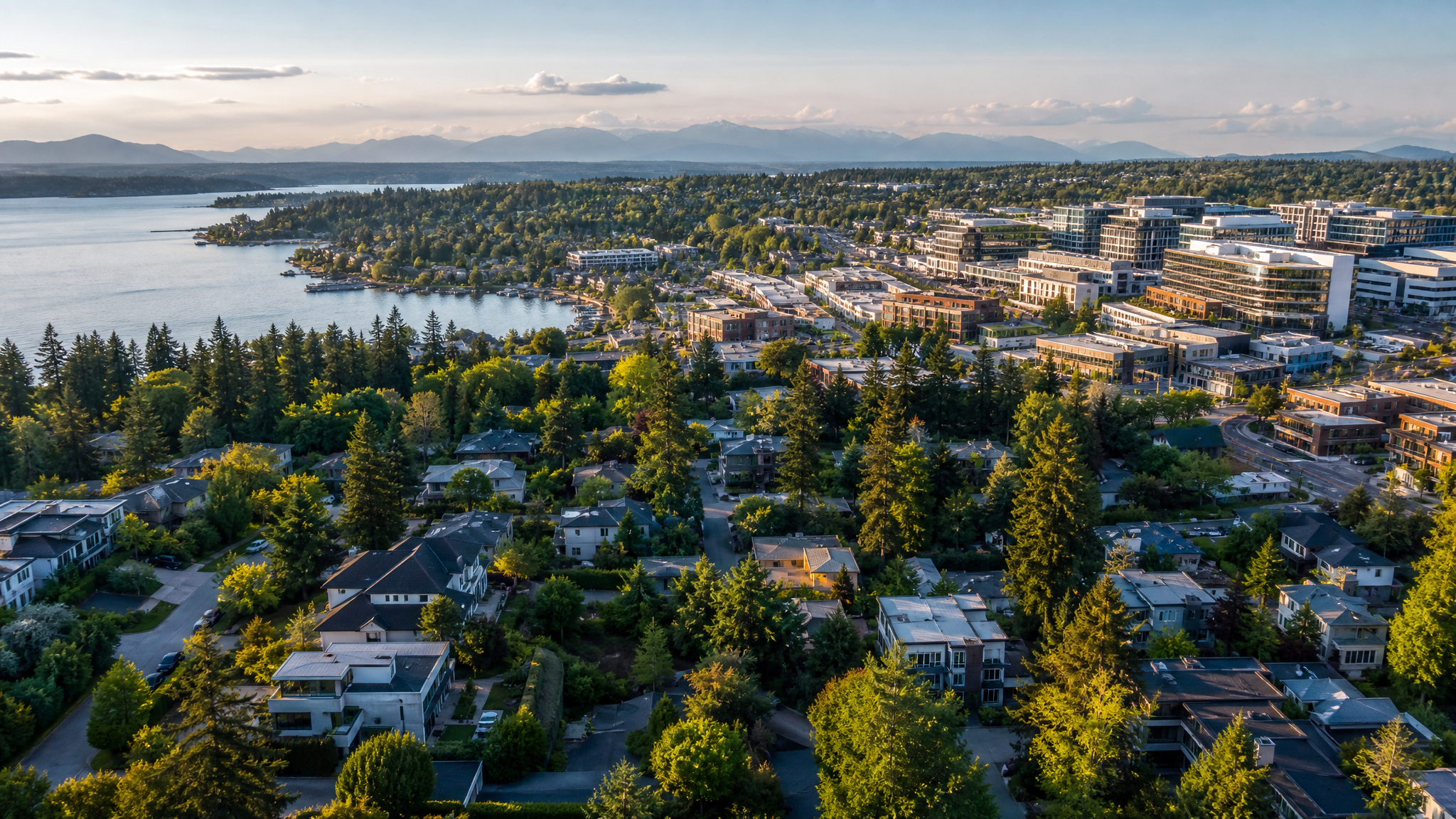
Kirkland’s calling card is its downtown: a genuinely walkable waterfront with restaurants, parks, a marina, and lake beaches (Marina Park, Juanita Beach). Neighborhoods like Houghton, Juanita, and Rose Hill offer everything from mid-century homes to new builds. If your ideal weekend is a lakeside walk, a paddleboard, and dinner you can stroll to, Kirkland delivers a lifestyle Redmond can’t quite match — and you pay for it.
Redmond — Convenient, Newer, Outdoorsy
Redmond is more suburban and practical, and for a Microsoft employee that’s often the point. You get newer housing stock, quick campus access, a growing downtown around the light rail stations, and easy reach to the Sammamish River Trail and Marymoor Park. Neighborhoods like Education Hill, Grass Lawn, and Redmond Ridge are popular with families who want space and a short commute. It’s less “night out on the water,” more “bike to work and home for dinner in 15 minutes.”
Kirkland vs. Redmond at a Glance
| Factor | Redmond | Kirkland |
|---|---|---|
| Commute to campus | Shortest | Moderate |
| Home price | Lower | Higher |
| Walkability | Growing | Excellent (downtown) |
| Waterfront lifestyle | Limited | Strong |
| New construction supply | Deeper | Thinner |
| Light rail access | Yes (2 Line) | Not yet |
| Schools | Lake WA (top-rated) | Lake WA (top-rated) |
So — Which One Should You Choose?
Choose Redmond if your priorities are a short, predictable commute (especially with light rail now serving the campus area), the most home for your budget, and a newer, family-friendly suburb. It’s the pragmatic pick for engineers who want to maximize time and square footage.
Choose Kirkland if a walkable, waterfront-town lifestyle genuinely improves your day-to-day and you’re comfortable paying a premium and adding roughly 10 minutes to your drive. For plenty of Microsoft employees — especially those without a daily on-campus requirement — that trade is easily worth it.
There’s no universally correct answer, only the one that fits your commute tolerance, your budget, and how you want to spend your weekends. That’s exactly the trade-off I help Microsoft employees weigh every week, and I can pull live listings in both cities so you’re comparing real homes, not just averages.
Deciding Between Kirkland and Redmond?
I’m Peter J Kim of Odigo Real Estate Club, and I help Microsoft employees buy smart across the Eastside. I’ll match your commute, budget, and lifestyle to the right neighborhood, map homes to their exact school boundaries, and time your purchase around your RSU vesting. Let’s compare real listings side by side.
Schedule a Free Consultation →Peter J Kim • Odigo Real Estate Club • WA License #112064 • 122 five-star Zillow reviews • Dave Ramsey Endorsed • 425-409-3823
Related reading: Microsoft Employee’s Guide to the Sammamish Plateau and Living in Edmonds and Commuting to Microsoft.