How to Win Bidding Wars in Seattle\'s Competitive Market: Expert Strategies for Tech Employees
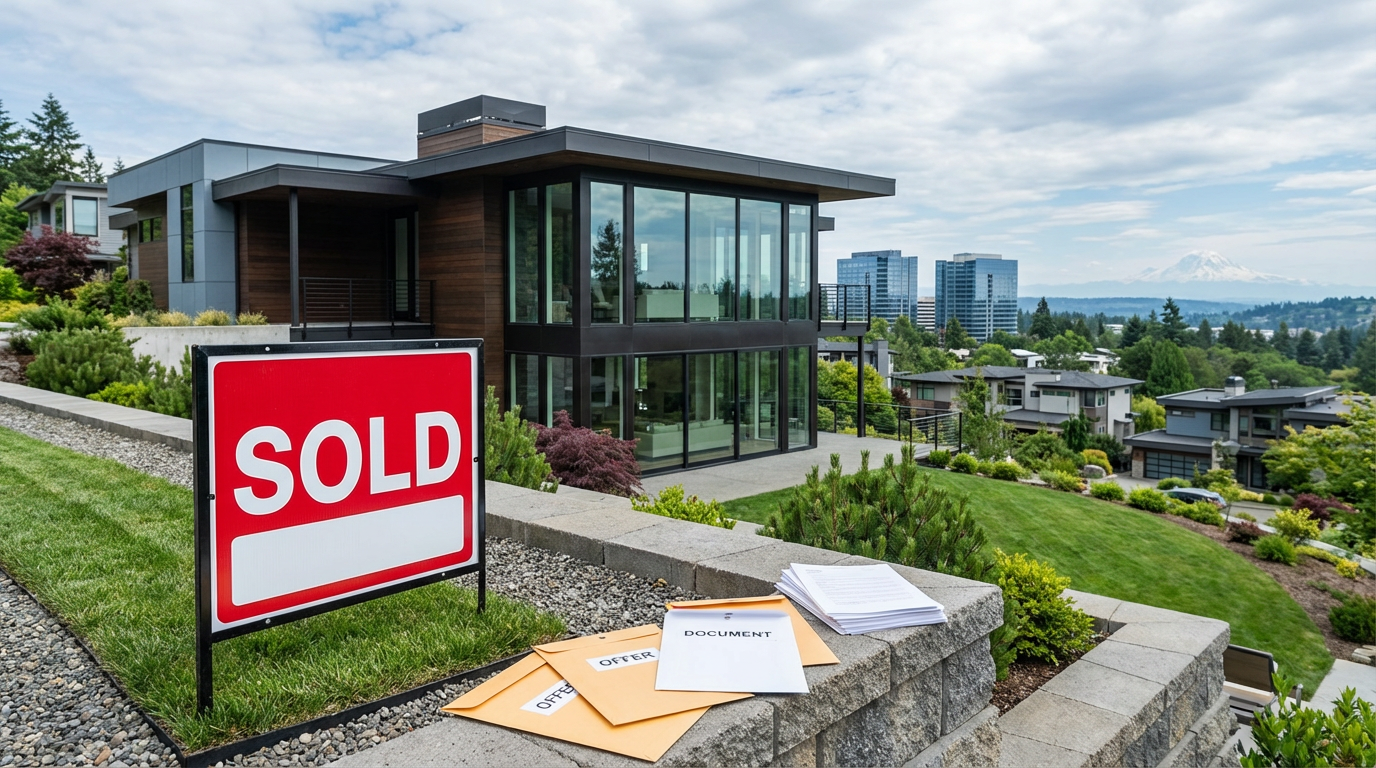
How to Win Bidding Wars in Seattle's Competitive Market: Expert Strategies for Tech Employees
If you're a tech professional working at Amazon, Microsoft, Google, or any of the major tech companies in the Seattle metro area, you've likely heard the horror stories: homes receiving 17 offers in Bellevue, properties going under contract in four days in Kirkland, and buyers offering tens of thousands over asking price only to lose out to even more aggressive bids. The Seattle real estate market, particularly on the Eastside, remains intensely competitive for desirable properties, and winning a bidding war requires far more than simply offering the highest price.
As a real estate agent specializing in helping tech employees navigate the Seattle, Bellevue, Redmond, and Kirkland markets, I've guided hundreds of clients through successful multiple-offer situations. In this comprehensive guide, I'll share the exact strategies that are winning bidding wars in 2026, from leveraging your RSU compensation to structuring offers that sellers simply can't refuse.
Understanding Seattle's Current Market Dynamics (2025-2026)
Before diving into specific strategies, it's crucial to understand the current state of the Seattle real estate market. The landscape has evolved significantly from the frenzied, all-cash, no-contingency environment of 2021-2022, but make no mistake—competition remains fierce for the right properties.
Market Conditions: A Selective Battleground
The Seattle metropolitan area in early 2026 is experiencing what experts call "selective competition." Not every property receives multiple offers, but the top 25-30% of listings—those that are well-priced, beautifully presented, and in desirable locations—still trigger intense bidding wars. This is particularly true for single-family homes in tech-heavy communities like Bellevue, Redmond, and Kirkland.
Key Market Statistics (2025-2026):
- Inventory Growth: King County saw a 25%+ year-over-year increase in active listings in late 2025, providing more choices for buyers
- Days on Market: Seattle homes averaged 27 days on market in late 2025, up from 21 days earlier in the year
- Sale-to-List Price Ratio: Hovering near 100%, with Bellevue at 97.4% and Kirkland at 96.7% in early 2026
- Price Appreciation: Forecasts predict 2-5% growth for 2026, a significant moderation from previous years
- Mortgage Rates: Stabilized in the low-to-mid 6% range, providing predictability for buyers
Neighborhood-Specific Competition Levels
Competition varies dramatically by location. Here's what you need to know about the most popular tech employee neighborhoods:
Bellevue: - Redfin Compete Score: 77 out of 100 (Very Competitive) - Average offers per property: 3 - Hot homes can receive 17+ offers - Top properties go under contract in 4 days - Sale-to-list price: 97.4% (early 2026)
Kirkland: - Redfin Compete Score: 70 out of 100 (Very Competitive) - Average offers per property: 2 - Desirable homes can attract 14+ offers - Premium properties sell in approximately 6 days - Sale-to-list price: 96.7% (early 2026)
Redmond: - Properties in attractive areas sell in 15-20 days - Frequently receives multiple offers due to proximity to Microsoft and other tech employers - Strong demand from families seeking excellent schools
The data is clear: if you're targeting a well-maintained home in a desirable neighborhood with good schools and proximity to tech campuses, you should expect competition and prepare accordingly.
The Foundation: Financial Preparation and Strength
In Seattle's competitive market, the strength of your financing is often more important than your offer price. Sellers evaluating multiple offers prioritize certainty and speed, which means your financial preparation can be the deciding factor.
The Hierarchy of Financial Preparedness
Not all pre-approvals are created equal. Understanding this hierarchy is critical:
1. Pre-Qualification (Insufficient) This is merely a cursory estimate based on self-reported information. It carries virtually no weight in a competitive market and should never be used for serious offers.
2. Standard Pre-Approval (Minimum Requirement) A lender verifies your income, assets, and debt, performs a hard credit check, and issues a formal letter stating your approved loan amount. This is the baseline for any competitive offer in Seattle.
3. Fully Underwritten Pre-Approval (The Gold Standard) This is the secret weapon that levels the playing field with cash buyers. In a fully underwritten pre-approval (also called pre-underwriting), you submit your complete financial profile—tax returns, pay stubs, bank statements, and all supporting documentation—to the lender's underwriting department before you've even identified a property.
The underwriter conducts a comprehensive review and provides a conditional commitment to lend, with the only remaining conditions typically being: - A satisfactory appraisal of the specific property - No adverse changes to your financial situation
Why This Matters:
A fully underwritten pre-approval allows you to confidently waive your financing contingency, making your offer nearly as strong as an all-cash bid. It also enables a much faster closing timeline (often 14-21 days instead of 30-45 days), which is highly attractive to sellers.
The process takes 1-2 weeks, so start early. Work with a reputable local lender who understands the Seattle market and can turn around underwriting quickly.
Leveraging Your Tech Compensation Package
As a tech employee, you have a significant advantage that many other buyers don't: access to substantial liquid capital through your equity compensation.
RSUs and Stock Options as Strategic Assets:
Restricted Stock Units (RSUs) and stock options from companies like Amazon, Microsoft, Google, and Meta provide powerful tools for winning bidding wars:
- Down Payment Strength: Vested RSUs can fund a larger down payment (20%+ vs. the minimum 3-5%), reducing your loan amount and monthly payment
- Appraisal Gap Coverage: This is where RSUs truly shine in competitive situations (more on this below)
- Cash Reserves: Demonstrating significant liquid assets beyond your down payment shows financial stability
- Earnest Money: Larger earnest money deposits (2-3% vs. 1%) signal serious commitment
Strategic Timing Considerations:
- Plan RSU vesting schedules around your home search timeline
- Understand tax implications of selling stock for real estate purchases
- Consider keeping some equity investments for long-term wealth building
- Work with a financial advisor to optimize your stock-to-real-estate conversion strategy
Many of my tech employee clients have successfully used $50,000-$150,000 in vested RSUs to cover appraisal gaps and strengthen their offers, often making the difference between winning and losing in multiple-offer situations.
Mastering the Escalation Clause: Washington's Competitive Edge
The escalation clause is one of the most powerful tools in Washington State real estate, but it must be used strategically to be effective.
How Escalation Clauses Work in Washington
Formalized in the Northwest Multiple Listing Service (NWMLS) Form 35E, an escalation clause allows your offer to automatically increase in response to higher competing offers. The clause has three critical components:
1. Initial Offer Price Your starting bid, which should be competitive but not your maximum
2. Escalation Increment The amount by which your offer will beat competing bids (typically $5,000-$10,000)
3. Maximum Price (Cap) The absolute highest price you're willing to pay
Example in Action:
You offer $1,000,000 on a Bellevue home with an escalation clause that increases your bid by $7,500 above any competing offer, up to a maximum of $1,150,000.
- If the highest competing offer is $1,050,000, your offer automatically escalates to $1,057,500
- If the highest competing offer is $1,160,000, your offer caps at $1,150,000 and you don't win
- The seller must provide you with a copy of the competing offer that triggered the escalation
Strategic Considerations for Escalation Clauses
Advantages: - Remain competitive without immediately revealing your maximum price - Avoid overpaying if competition is less intense than expected - Demonstrate serious intent while maintaining some negotiating flexibility
Disadvantages: - Reveals your maximum budget to the seller - Seller may counter all offers at or near your cap - Can create a "race to the top" mentality
Best Practices:
- Set realistic increments: $5,000-$7,500 is standard; $10,000+ for luxury properties
- Know your true maximum: Set your cap at the absolute highest you can afford and are willing to pay
- Combine with other strengths: An escalation clause alone won't win—pair it with strong contingency terms
- Be prepared to prove competing offers: The seller must show you the offer that triggered your escalation
- Consider market conditions: In slower markets, a strong fixed-price offer may be more effective
When NOT to Use an Escalation Clause
- When you're already offering significantly above asking price
- In slower market conditions with limited competition
- When you want to keep your maximum budget confidential
- If you're making an all-cash offer (the certainty is already your advantage)
Appraisal Gap Coverage: The Game-Changer
In a market where escalation clauses can drive purchase prices above recent comparable sales, appraisal gap coverage has become essential for competitive offers.
Understanding the Appraisal Gap Problem
Here's the scenario that keeps sellers up at night:
- Your escalated offer of $1,200,000 is accepted
- The lender orders an appraisal
- The appraisal comes in at $1,150,000
- The lender will only finance based on the appraised value ($1,150,000)
- You need to cover the $50,000 gap in cash, or the deal falls apart
Without a plan to address this potential issue, even a high offer carries significant risk for the seller.
The Solution: NWMLS Form 22AD (Low Appraisal Addendum)
This form allows you to proactively specify the amount of cash you're willing to pay out-of-pocket if an appraisal gap occurs. This commitment provides tremendous reassurance to sellers.
Example Scenarios:
Scenario 1: Moderate Coverage - Purchase price: $1,200,000 - Appraisal gap coverage: $30,000 - If appraisal comes in at $1,170,000 or higher: You cover the gap - If appraisal comes in below $1,170,000: You can renegotiate or walk away
Scenario 2: Aggressive Coverage - Purchase price: $1,200,000 - Appraisal gap coverage: $75,000 - Demonstrates serious financial strength and commitment - Significantly reduces seller's risk
Scenario 3: Full Waiver (Extremely Aggressive) - Waive the appraisal contingency entirely - Agree to purchase at contract price regardless of appraisal - Only advisable with very deep cash reserves
How Much Gap Coverage Should You Offer?
The right amount depends on several factors:
Market Factors: - Level of competition (more offers = more coverage needed) - How far above recent comps you're bidding - Neighborhood appreciation trends
Personal Factors: - Available liquid assets (RSUs, savings, investments) - Risk tolerance - How badly you want this specific property
Typical Ranges in Seattle (2026): - Moderate competition: $20,000-$40,000 - High competition: $50,000-$75,000 - Extreme competition: $75,000-$150,000+
Many of my tech employee clients offer $50,000-$100,000 in appraisal gap coverage, funded by vested RSUs. This level of commitment often makes the difference in winning against other strong offers.
Important Legal Update: New Washington Appraisal Law (Effective January 1, 2026)
Washington's RCW 61.40.010 creates a new statutory appraisal contingency for unrepresented sellers in off-market transactions. If an unrepresented seller receives an unsolicited offer, they have the right to:
- Obtain an appraisal at the buyer's expense
- Terminate the purchase agreement within four days of receiving the appraisal results, regardless of the valuation
This introduces new risk for buyers pursuing off-market deals, as the seller has a unilateral "cooling-off" period. Work with an experienced agent to navigate these situations.
The High-Stakes Decision: Waiving Contingencies
Waiving contingencies is the most powerful—and riskiest—strategy for winning bidding wars. Understanding when and how to waive contingencies can mean the difference between success and financial disaster.
The Three Major Contingencies
1. Inspection Contingency
What it protects: Your right to have the home professionally inspected and either negotiate repairs or terminate the contract based on the findings.
Waiving it means: You're buying the property "as-is" with no recourse for defects or needed repairs.
The Risk: You could inherit major problems like foundation issues, roof failure, electrical hazards, or plumbing disasters, potentially costing tens of thousands in unexpected repairs.
The Mitigation Strategy: Pre-Inspection
The smart way to waive an inspection contingency is to conduct a pre-inspection before submitting your offer:
- Schedule a professional home inspection during the showing period
- Review the inspection report thoroughly
- Get repair estimates for any issues identified
- Make an informed decision about whether to proceed
- If you move forward, waive the inspection contingency with confidence
Cost: $400-$700 for a standard inspection Timeline: Can usually be scheduled within 24-48 hours Value: Priceless peace of mind and competitive advantage
When to waive (with pre-inspection): - Newer homes (less than 10 years old) in good condition - Properties you've thoroughly researched - When you have cash reserves for potential repairs - In highly competitive situations where it's necessary to win
When NOT to waive: - Older homes (30+ years) without recent updates - Properties with visible red flags - Homes with additions or unpermitted work - When you're stretching your budget and can't afford surprises
2. Financing Contingency
What it protects: Your right to terminate the contract if you can't secure financing.
Waiving it means: You're guaranteeing you'll complete the purchase, even if your loan falls through.
The Risk: If you fail to obtain financing for any reason—job loss, credit issues, lender problems—you'll be in breach of contract and will likely forfeit your earnest money deposit (typically 1-3% of the purchase price).
The ONLY Safe Way to Waive: Fully Underwritten Pre-Approval
Never waive a financing contingency with just a standard pre-approval. The only way to safely waive this contingency is with a fully underwritten pre-approval that provides near-certainty your loan will fund.
Requirements for safely waiving: - Fully underwritten pre-approval in hand - No anticipated changes to employment or income - Stable credit profile - Sufficient reserves beyond down payment and closing costs
When to waive: - You have a fully underwritten pre-approval - You're confident in your job security - The property will clearly appraise (or you have gap coverage) - You need maximum competitive advantage
When NOT to waive: - You only have a standard pre-approval - You're changing jobs soon - You have any credit concerns - You're not 100% certain about loan approval
3. Appraisal Contingency
What it protects: Your right to renegotiate or walk away if the appraisal comes in below the purchase price.
Important Distinction: Offering appraisal gap coverage (Form 22AD) is different from waiving the appraisal contingency entirely.
- Gap coverage with a limit: "I'll cover up to $50,000 if the appraisal is low"
- Full waiver: "I'll pay the full purchase price regardless of appraisal value"
Waiving it entirely means: You're obligated to cover any and all appraisal shortfalls, with no limit.
The Risk: If you're offering $1,500,000 and the appraisal comes in at $1,350,000, you must cover the $150,000 gap in cash or be in breach of contract.
When to waive: - You have very deep cash reserves - You're making an all-cash offer anyway - You're absolutely certain of the property's value - You're in an extreme bidding war for your dream home
When NOT to waive: - You're using financing (use gap coverage instead) - You don't have substantial liquid assets - You're bidding significantly above recent comps - You have any doubts about the property's value
Strategic Contingency Combinations
The most successful offers in Seattle's 2026 market typically use one of these combinations:
The "Strong Financed Offer" (Most Common for Tech Employees): - ✅ Waive financing contingency (with fully underwritten pre-approval) - ✅ Waive inspection contingency (with pre-inspection) - ✅ Offer $50,000-$100,000 appraisal gap coverage - ✅ Include escalation clause - Result: Nearly as strong as cash, but using financing
The "Calculated Risk" (Moderate Competition): - ✅ Keep financing contingency (standard pre-approval) - ✅ Waive inspection contingency (with pre-inspection) - ✅ Offer $30,000-$50,000 appraisal gap coverage - ✅ Include escalation clause - Result: Competitive but with some protection
The "All-In" (Extreme Competition): - ✅ Waive financing contingency (fully underwritten) - ✅ Waive inspection contingency (pre-inspection) - ✅ Waive appraisal contingency entirely OR offer $100,000+ gap coverage - ✅ Include aggressive escalation clause - ✅ Larger earnest money deposit (3%+) - Result: Maximum competitiveness, maximum risk
Additional Strategic Advantages
Beyond the core financial and contingency strategies, several other factors can give you an edge in multiple-offer situations.
The Power of an Experienced Local Agent
In a complex, fast-moving market like Seattle, working with a deeply experienced local real estate agent is invaluable. Here's what a top agent brings to the table:
Market Intelligence: - Inside knowledge of neighborhood trends and pricing - Relationships with listing agents that can provide insight into seller priorities - Understanding of what strategies are working in current market conditions
Strategic Counsel: - Guidance on optimal offer structure for specific properties - Advice on how much to escalate and what contingencies to waive - Negotiation expertise in multiple-offer situations
Process Management: - Coordination of pre-inspections, appraisals, and underwriting - Ensuring all deadlines are met and paperwork is perfect - Problem-solving when issues arise
Competitive Advantages: - Sometimes can learn the number of competing offers - May know seller's timeline and priorities - Can position your offer in the most favorable light
I've seen countless situations where the right agent made the difference between winning and losing, not through any magic trick, but through experience, relationships, and strategic thinking.
Personal Letters to Sellers: The Legal Risks
For years, buyers were encouraged to write "love letters" to sellers—personal notes designed to create an emotional connection. However, this practice is now strongly discouraged and carries significant legal risk.
The Problem: Fair Housing Violations
The federal Fair Housing Act prohibits discrimination based on: - Race - Color - Religion - Sex - Familial status - National origin
A personal letter, even with the best intentions, can inadvertently reveal information about protected classes. If a seller chooses a buyer based on such a letter, it could expose both the seller and the agents to accusations of housing discrimination.
Current Best Practice:
Professional real estate organizations and brokerages now advise against writing or accepting personal letters. Instead:
- Focus on strengthening the objective, financial terms of your offer
- Let your agent communicate your seriousness and qualifications
- Demonstrate commitment through financial strength, not emotional appeals
Timing Strategies and Market Seasonality
While Seattle has year-round demand, understanding seasonal patterns can provide strategic advantages:
Spring Market (March-June): - Highest competition and most inventory - Best selection of properties - Expect multiple offers on desirable homes - Strategy: Be prepared to move quickly and compete aggressively
Summer (July-August): - Still active but slightly less frenzied - Families want to move before school starts - Strategy: Good balance of inventory and competition
Fall (September-October): - Market begins to slow - Fewer buyers but also less new inventory - Strategy: May find motivated sellers willing to negotiate
Winter (November-February): - Lowest competition but also lowest inventory - Sellers on market are often motivated - Longer days on market - Strategy: More negotiating power, but limited selection
Current Market Note (2026):
With median days on market increasing to 27 days in Seattle, buyers have more time to evaluate properties than in previous years. This doesn't mean you should delay—desirable properties still move quickly—but you may have slightly more breathing room for due diligence.
Closing Timeline Flexibility
Sellers often have specific timeline needs. Offering flexibility can be a tiebreaker:
Fast Close (14-21 days): - Requires fully underwritten pre-approval - Attractive to sellers who need quick liquidity - May need to waive some contingencies
Standard Close (30-45 days): - Most common timeline - Allows for full due diligence - Works with standard pre-approval
Delayed Close (60+ days): - Can be attractive to sellers who need time to find their next home - Allows them to avoid temporary housing - Less common but can be a strategic advantage
Rent-Back Agreements:
Offering to let the seller rent the property back for 30-60 days after closing can be very attractive: - Seller gets their equity but doesn't have to move immediately - Reduces their stress and timeline pressure - Can be the deciding factor in close offer situations
Real-World Success: A Case Study
Let me share a recent example that illustrates these strategies in action. (Details have been modified to protect client privacy.)
The Property: A 4-bedroom, 2,800 sq ft home in Bellevue's Bridle Trails neighborhood, listed at $1,600,000. Excellent schools, updated kitchen, large lot. The listing agent indicated they expected multiple offers.
The Buyers: A couple working at Microsoft and Amazon, combined income of $450,000, with approximately $300,000 in vested RSUs and $150,000 in savings.
The Competition: The property received 17 offers, ranging from $1,625,000 to $1,815,000.
Our Strategy:
- Financial Preparation (2 weeks before offer):
- Obtained fully underwritten pre-approval from a local lender
- Liquidated $100,000 in vested RSUs for gap coverage and reserves
-
Prepared to close in 21 days
-
Due Diligence (During showing period):
- Conducted pre-inspection ($650)
- Inspection revealed minor issues (estimated $3,000 in repairs)
-
Decided to proceed and waive inspection contingency
-
Offer Structure:
- Initial offer: $1,650,000
- Escalation clause: $7,500 increments up to $1,825,000 maximum
- Waived financing contingency (backed by fully underwritten pre-approval)
- Waived inspection contingency (backed by pre-inspection)
- Offered $100,000 appraisal gap coverage (Form 22AD)
- 3% earnest money deposit ($49,500)
-
21-day close with 30-day rent-back option for seller
-
The Competition:
- Highest competing offer: $1,815,000
- Our escalated price: $1,812,500 (triggered by $1,805,000 offer)
- We were $2,500 below the highest offer
The Result:
The seller chose our offer despite it being $2,500 lower than the highest bid. Why?
- The highest offer retained a financing contingency (only standard pre-approval)
- Our offer had no financing contingency (fully underwritten)
- Our offer had no inspection contingency (pre-inspection completed)
- Our $100,000 gap coverage provided certainty
- Our 21-day close was faster than most competitors
- The rent-back option gave the seller flexibility
The Outcome:
- Appraisal came in at $1,790,000
- We covered the $22,500 gap as committed (well within our $100,000 limit)
- Closed in 21 days
- Seller rented back for 45 days
- Total out-of-pocket: $362,500 (20% down) + $22,500 (gap) = $385,000
This case perfectly illustrates the central principle of winning bidding wars in 2026: certainty and clean terms often beat a marginally higher price with more risk.
Your Action Plan: Steps to Win Your Next Bidding War
Ready to compete successfully in Seattle's market? Here's your step-by-step action plan:
Phase 1: Financial Preparation (4-6 weeks before house hunting)
Week 1-2: - [ ] Meet with 2-3 local lenders to compare rates and services - [ ] Choose a lender and begin the fully underwritten pre-approval process - [ ] Gather all required documentation (tax returns, pay stubs, bank statements, RSU vesting schedules) - [ ] Review your credit report and address any issues
Week 3-4: - [ ] Complete underwriting process - [ ] Receive fully underwritten pre-approval letter - [ ] Calculate your maximum comfortable purchase price - [ ] Determine available funds for down payment, gap coverage, and reserves - [ ] Plan RSU liquidation strategy if needed
Week 5-6: - [ ] Interview 2-3 experienced local real estate agents - [ ] Choose an agent with proven success in competitive situations - [ ] Define your target neighborhoods and property criteria - [ ] Set up automated listing alerts
Phase 2: Property Search and Due Diligence
For Each Potential Property: - [ ] Attend showings promptly (within 24-48 hours of listing) - [ ] Research recent comparable sales in the neighborhood - [ ] Assess competition level (days on market, showing activity) - [ ] If seriously interested, schedule pre-inspection immediately - [ ] Review inspection report and get repair estimates - [ ] Determine your maximum offer price for this specific property
Phase 3: Offer Strategy and Submission
24-48 Hours Before Offer Deadline: - [ ] Consult with your agent on optimal offer structure - [ ] Decide on escalation clause parameters (initial, increment, maximum) - [ ] Determine appraisal gap coverage amount - [ ] Decide which contingencies to waive (based on pre-inspection and underwriting) - [ ] Consider timing flexibility and rent-back options - [ ] Prepare earnest money deposit
Offer Submission: - [ ] Submit complete offer package with all required forms - [ ] Include fully underwritten pre-approval letter - [ ] Include pre-inspection report (if waiving inspection) - [ ] Include proof of funds for down payment and gap coverage - [ ] Ensure all signatures and dates are correct
Phase 4: Negotiation and Closing
If Your Offer is Accepted: - [ ] Review and sign final purchase agreement - [ ] Submit earnest money within required timeframe - [ ] Order appraisal immediately - [ ] Maintain close communication with lender - [ ] Prepare for potential appraisal gap - [ ] Complete final walk-through - [ ] Attend closing and get your keys!
If Your Offer is Not Accepted: - [ ] Request feedback from listing agent (through your agent) - [ ] Analyze what could be improved for next offer - [ ] Adjust strategy based on lessons learned - [ ] Continue search with refined approach
Common Mistakes to Avoid
Even experienced buyers make these critical errors in competitive situations:
1. Insufficient Financial Preparation - Relying on standard pre-approval instead of fully underwritten - Not having enough liquid assets for gap coverage - Underestimating total cash needed
2. Emotional Decision-Making - Falling in love with a property before inspection - Bidding beyond comfortable financial limits - Waiving contingencies without proper mitigation
3. Poor Timing - Waiting too long to schedule pre-inspection - Missing offer deadlines - Not being available for quick decision-making
4. Inadequate Research - Not understanding neighborhood comps - Failing to assess true competition level - Overlooking property issues that could affect value
5. Weak Offer Structure - Using escalation clause with too-low maximum - Insufficient appraisal gap coverage - Keeping unnecessary contingencies
6. Agent Selection - Choosing an inexperienced agent to save on commission - Working with an agent unfamiliar with your target neighborhoods - Not leveraging agent's market knowledge and relationships
Frequently Asked Questions
Q: Should I always use an escalation clause?
A: Not always. Escalation clauses work best in clearly competitive situations. If you're already offering significantly above asking, or if the market is slower, a strong fixed-price offer may be more effective. Your agent can advise based on specific circumstances.
Q: How much should I offer above asking price?
A: This depends entirely on the property, neighborhood, and competition level. In early 2026, homes in Bellevue are selling at an average of 97.4% of list price, while hot properties still sell above asking. Research recent comps and consult your agent for property-specific guidance.
Q: Is it worth waiving the inspection contingency?
A: Only with a pre-inspection. Never waive an inspection contingency blind. The $400-$700 cost of a pre-inspection is a small price to pay for the competitive advantage and peace of mind it provides.
Q: Can I win without waiving contingencies?
A: In moderate competition, yes. In high competition for premium properties, it's very difficult. The key is to make your offer as clean and certain as possible while maintaining protections you absolutely need.
Q: How do I know if I'm offering too much?
A: Set your maximum price based on: - Comparable sales data - Your budget and financial comfort level - The property's value to you personally - Your agent's market expertise
Never bid beyond what you can comfortably afford, even in a competitive situation.
Q: What if I lose multiple bidding wars?
A: This is frustrating but common. After each loss: - Get feedback on why your offer wasn't chosen - Assess whether you need to adjust your strategy or budget - Consider expanding your search criteria - Stay patient—the right property will come
Q: Should I make an all-cash offer if I can?
A: Cash offers are extremely powerful, but not always necessary. A fully underwritten financed offer with waived contingencies can be nearly as strong. Consider: - Opportunity cost of tying up cash vs. keeping it invested - Current mortgage rates vs. investment returns - Your overall financial strategy
Many tech employees are better served keeping their RSUs invested and using strategic financing.
Take the Next Step: Let's Win Your Bidding War Together
Winning a bidding war in Seattle's competitive market requires expertise, strategy, and flawless execution. As a real estate agent specializing in helping tech employees navigate the Bellevue, Redmond, Kirkland, and Seattle markets, I've successfully guided hundreds of clients through multiple-offer situations.
What I Bring to Your Home Search:
- Deep Market Knowledge: Years of experience in Seattle's most competitive neighborhoods
- Tech Employee Expertise: Understanding of RSU compensation, stock options, and tech company benefits
- Proven Strategies: Track record of winning bidding wars with smart, strategic offers
- Lender Relationships: Connections with top local lenders who can provide fully underwritten pre-approvals
- Negotiation Skills: Ability to position your offer for maximum appeal to sellers
Ready to Start Your Home Search?
Whether you're just beginning to explore the market or you're ready to make an offer this week, I'm here to help you succeed.
Contact Peter J Kim: - Email: [email protected] - Phone: 425-409-3823
Let's schedule a consultation to discuss your specific situation, review your financial preparation, and develop a winning strategy for your home search.
Related Resources
Looking for more information to help with your home buying journey? Check out these related articles:
- Amazon Employee Home Buying Guide - Comprehensive guide for Amazon employees navigating the Seattle real estate market
- Microsoft Employee Home Buying Guide - Strategies specific to Microsoft employees in the Redmond area
- RSUs and Stock Options for Down Payment - How to leverage your equity compensation for real estate
- Tech Employee Relocation Guide - Everything you need to know about relocating to the Seattle area
- Seattle vs Eastside: 2025 Real Estate Price Comparison - Detailed comparison of Seattle and Eastside markets
- Best Neighborhoods for Amazon Employees - Top neighborhoods for Amazon employees by commute, schools, and lifestyle
This article was last updated on March 2, 2026. Market conditions and strategies evolve over time. Contact me for the most current information and personalized advice for your situation.
Written by
Peter J Kim