Atlassian Is Remote-First — Where Should Its Seattle-Area Employees Buy a Home in 2026?
Quick Answer
Because Atlassian runs a fully distributed “Team Anywhere” model, its Seattle-area employees don't have to buy near an office — there is no daily commute anchoring the decision. That freedom is worth real money: instead of paying the Bellevue/Redmond premium for a short drive, remote-first Atlassian employees can chase space, schools, and value in areas most tech workers rule out. The strongest 2026 plays are Ballard, Columbia City and West Seattle for in-city character (roughly $800K–$1.1M), Bothell, Mill Creek and Marysville in the north for the most house per dollar ($650K–$900K), and Tacoma or Bremerton if you want to stretch a tech salary the furthest (often under $600K). The one thing that changes for a remote buyer: prioritize a real home-office room and reliable fiber internet over proximity to a light-rail station.
Most Seattle tech home-buying advice starts with a commute map: how close can you get to the Amazon towers, the Microsoft campus, or the Google offices in Kirkland? For Atlassian employees, that whole framework is beside the point. Atlassian is one of the few large software companies that went permanently, genuinely remote — its “Team Anywhere” policy lets employees work from home indefinitely, with only occasional team gatherings. If you work for Atlassian in the Seattle area, your house doesn't need to be near anything except the life you actually want.
That reframes the entire buying decision, and in a market as expensive as Puget Sound, it's a genuine financial advantage. This guide is written for Atlassian engineers, PMs, and designers living in Greater Seattle who want to know how to turn location freedom into a smarter purchase — which neighborhoods deliver the most value once commute drops out of the equation, what your compensation can actually buy in 2026, and the two things a remote buyer should never compromise on.
Why “Team Anywhere” Changes the Math
In the Seattle market, proximity to a major tech campus carries a measurable premium. A home a short drive from Microsoft's Redmond campus or Amazon's Bellevue towers can cost $150,000–$400,000 more than a comparable house 30–45 minutes farther out. For a commuting employee, paying that premium is rational — time is the scarcest resource. For a remote-first Atlassian employee, it's money left on the table.
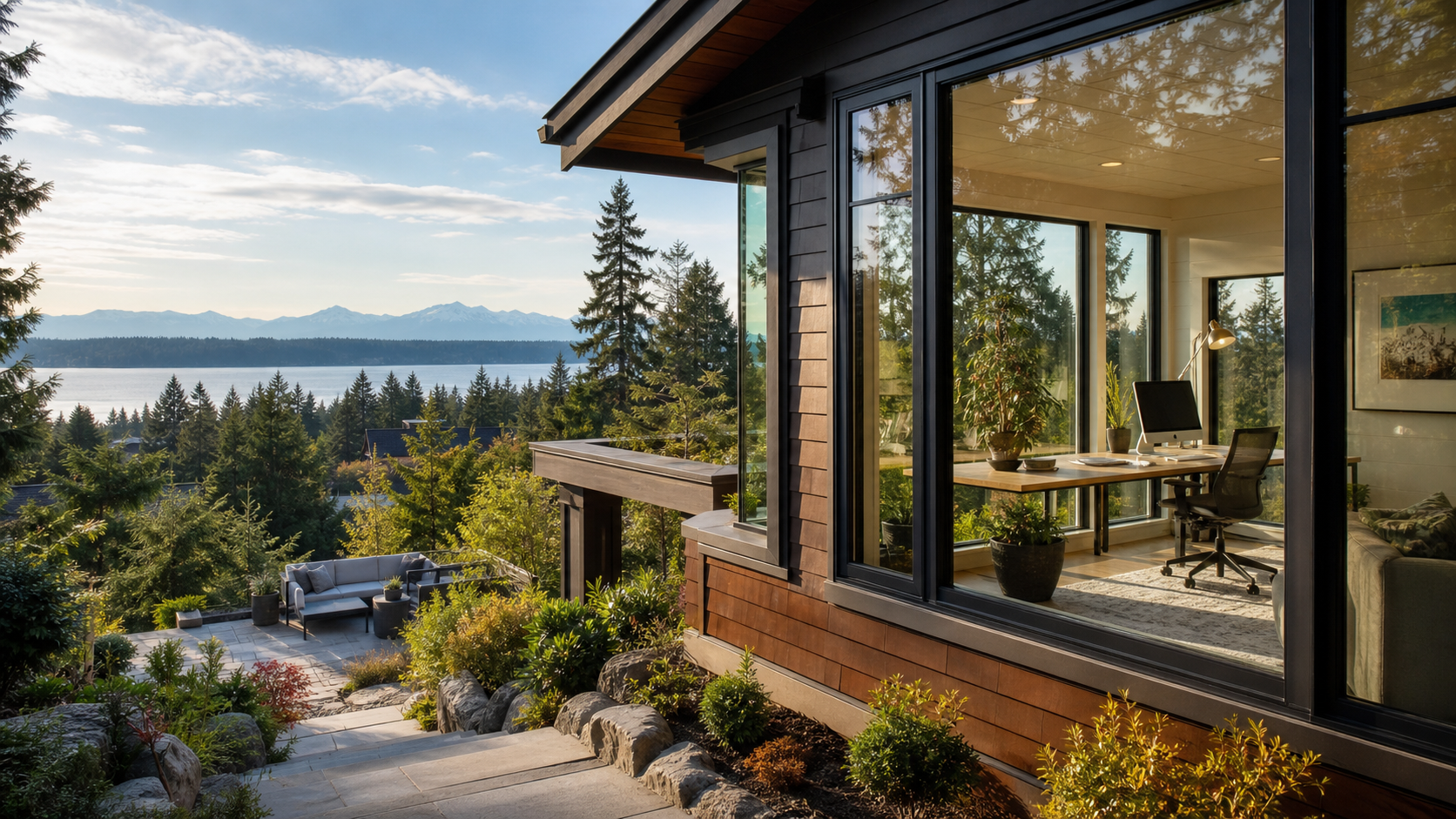
When you never have to sit in I-405 traffic, the calculus flips. You can optimize for square footage, a real yard, a top-rated school, or simply a lower mortgage — the things that actually shape daily life — instead of shaving minutes off a drive you'll never make. The trade-off is that you take on two new priorities most buyers ignore: a dedicated, quiet home office (not a corner of the bedroom), and rock-solid internet, ideally fiber. Get those right and the entire region opens up to you.
The Remote Buyer's Priority Shift
| Commuting buyer prioritizes | Remote Atlassian buyer prioritizes |
|---|---|
| Minutes to campus | A quiet, dedicated office room |
| Light-rail / freeway access | Fiber internet & a backup connection |
| Walkable urban core | Square footage & a yard |
| Paying the campus premium | School quality & overall value |
Atlassian does maintain occasional in-person team gatherings, so a manageable drive or flight to a central meetup spot is worth a passing thought — but it should not drive your purchase.
The Best Value Neighborhoods for Remote-First Atlassian Employees
I've grouped these by what kind of life you're after. Since commute is off the table, the only question is which trade-offs fit you — city energy, family space, or maximum affordability.
In-City Character — Ballard, Columbia City & West Seattle
If you love walkable coffee shops, breweries, and a neighborhood identity, you no longer have to pay for a downtown-adjacent address. Ballard offers Scandinavian charm, the Sunday farmers market, and a mix of classic bungalows and new townhomes generally in the $850,000–$1,100,000 range. Columbia City in southeast Seattle is one of the city's most diverse and food-rich neighborhoods, with craftsman homes often $800,000–$1,000,000. West Seattle gives you beach-town character at Alki and pockets of relative value, typically $750,000–$1,050,000. None of these require you to care about a bridge or a bus schedule anymore.
Family Space — Bothell, Mill Creek & Woodinville
For remote employees with kids, the north-end suburbs deliver room and strong schools without the Eastside campus tax. Bothell and Mill Creek pair well-regarded Northshore and Everett-area schools with newer construction, generally $750,000–$1,000,000 for a comfortable single-family home. Woodinville adds wine-country character and larger lots, often $900,000–$1,300,000. These are the classic “more house, better schools” picks — and a commuting Microsoft employee often can't justify them because the drive is real. You can.
Maximum Value — Marysville, Tacoma & Bremerton
If your goal is to own outright faster, minimize your mortgage, or buy a much bigger home, going farther out is where a remote salary becomes a superpower. Marysville and the north Snohomish communities offer newer detached homes frequently in the $600,000–$750,000 range. Tacoma — a genuinely characterful city with a revitalized downtown — still has solid homes under $600,000 in many neighborhoods. Across the water, Bremerton and the Kitsap Peninsula offer waterfront and acreage for prices that feel like a different decade. The catch is you're trading proximity to Seattle amenities for value — but as a remote worker, you only make that trip when you want to, not when you have to.
2026 Price Snapshot by Area
| Area | Typical home range | Best for |
|---|---|---|
| Tacoma | Under $600K | Lowest entry, city character |
| Marysville / N. Snohomish | $600K–$750K | New construction value |
| West Seattle | $750K–$1.05M | Beach-town in-city living |
| Bothell / Mill Creek | $750K–$1.0M | Family space & schools |
| Columbia City | $800K–$1.0M | Diverse, walkable, food scene |
| Ballard | $850K–$1.1M | Classic Seattle character |
| Woodinville | $900K–$1.3M | Larger lots, wine country |
Ranges are directional for 2026 and vary by home size, condition, and micro-location. Waterfront and view properties trend higher.
What Can You Afford on Atlassian Compensation?
Atlassian pays competitive total compensation built on a base salary plus RSUs (restricted stock units in TEAM) and an annual bonus. A mid-level engineer in the Seattle market commonly lands in the $180,000–$260,000 total-comp range, with senior and staff levels going well beyond. As with other tech employers, lenders will count a documented two-year history of vesting RSUs toward your qualifying income — which is exactly why working with a lender who understands equity compensation matters. Here's a rough monthly principal-and-interest picture at a mid-6% rate with 20% down:
Down Payment & Monthly Payment (20% down, ~6.5%)
| Home price | 20% down | Est. monthly P&I |
|---|---|---|
| $575,000 | $115,000 | ~$2,910 |
| $750,000 | $150,000 | ~$3,790 |
| $900,000 | $180,000 | ~$4,550 |
| $1,100,000 | $220,000 | ~$5,560 |
Estimates exclude property taxes, insurance, and any HOA dues. Actual rates depend on your lender and credit profile. Washington has no state income tax, which meaningfully improves your take-home versus California or New York.
Notice how far a remote-first choice stretches: the difference between a $1.1M home near a campus and a $750K home in Bothell or Marysville is roughly $1,770 a month in payment — over $21,000 a year you keep because you don't need the short commute. Want to run your own numbers? Try our RSU down payment calculator.
Using Your RSUs for a Down Payment When You Can Live Anywhere
The equity playbook for Atlassian employees is similar to any tech buyer's, with one twist: because you're not paying a location premium, your RSUs go further, so you have more flexibility on how aggressively to deploy them.
- Sell RSUs at vest to fund the down payment. TEAM shares are taxed as ordinary income when they vest. Selling right away typically means little or no additional capital-gains tax and avoids leaving your down payment exposed to a single stock's swings.
- Don't over-concentrate. If a big share of your net worth is already in TEAM, resist the urge to hold it all hoping for a pop before you buy. A blown-up closing because your down payment dropped 20% in a bad week is a painful, avoidable mistake.
- Let location freedom lower your risk. Because a remote-first budget can target a lower price point, you may be able to put down a larger percentage — or buy comfortably without stretching — which makes your whole financial picture sturdier.
- Keep reserves. Lenders like to see cash left after closing, and you'll want a cushion for the home office build-out, furniture, and the inevitable first-year repairs.
For a deeper dive on structuring equity for a purchase, see my guides on maximizing your RSU vesting schedule for a down payment and using an ESPP toward your down payment.
Two Things a Remote Buyer Should Never Skip
When your home is also your office, two due-diligence items jump to the top of the list that most buyers barely check. First, verify the internet. Don't assume — look up the exact address on the providers' availability tools and confirm whether fiber (Ziply, CenturyLink fiber, or comparable) actually reaches the property, not just the street. In rural Kitsap or far-north Snohomish, service can vary house to house. Second, protect a real office space. A dedicated room with a door beats a loft or a nook every time for calls and focus — and it can pay off at resale, since remote work isn't going away. During tours, I help Atlassian clients evaluate exactly these things alongside the usual inspection red flags.
Work From Anywhere? Let's Find Your Best Value.
I'm Peter J Kim of Odigo Real Estate Club, and I specialize in helping Seattle-area tech employees buy smart. For remote-first Atlassian employees, that means turning your location freedom into real savings — matching your budget and lifestyle to the right neighborhood, vetting internet and home-office fit, and timing your purchase around your RSU vesting with a tech-fluent lender.
Schedule a Free Consultation →Peter J Kim • Odigo Real Estate Club • WA License #112064 • 122 five-star Zillow reviews • Dave Ramsey Endorsed • 425-409-3823
Related reading: Lynnwood & Mill Creek Home Buying Guide for Tech Workers.
Talk to Odigo Real Estate Club
Peter J Kim and John Kim · Monday–Saturday 9 AM–6 PM
Odigo Real Estate Club · REAL Brokerage · WA License #112064 · 16108 Ash Way, Suite 201, Lynnwood, WA 98087 · Equal Housing Opportunity